
India has successfully conducted a flight test of an advanced Agni missile featuring Multiple Independently Targetable Re-entry Vehicle (MIRV) technology off the coast of Odisha.

'Exploration should be made easier and companies should be given operational flexibility.'

Haryana Chief Minister Nayab Singh Saini criticises the AAP-led Punjab government for political instability and lack of industrial development, while promoting Haryana's investor-friendly policies and industrial growth initiatives.

Lucknow Super Giants' global director of cricket, Tom Moody, attributes the team's IPL exit to inconsistent batting performances, particularly in the middle order. Jamie Overton of CSK credits his success to simple execution and praises the team environment.

The US Navy seized an Iranian-flagged cargo ship in the Gulf of Oman, escalating tensions as ceasefire talks face uncertainty. The incident raises concerns about the fragile ceasefire and the ongoing blockade of the Strait of Hormuz.

Israel's Defence Minister Israel Katz has stated that Israel is prepared to escalate military action against Iran, pending approval from the United States. This comes as US President Donald Trump says he would not use nuclear weapons in any conflict with Iran, while also claiming the US has 'total control' over the Strait of Hormuz.

'It was diminishing even before Trump came to power.' 'The US was at the centre of the global economy. That position is going to become less and less important and less central.'

India's power sector CO2 emissions fell in H1 2025 for the first time in nearly 50 years (outside the pandemic), thanks to record renewable growth and lower coal use from cooler, wetter weather.

The threat has raised concerns about possible asymmetric attacks outside the region. Iran has also stepped up attacks on energy infrastructure in Gulf countries.

The RBI has enough "fire power" to deal with the rupee volatility and will intervene in the forex market as and when required, said Planning Commission Deputy Chairman Montek Singh Ahluwalia.

It may now be time to question the price India is paying for Israel's disregard of the serious undermining of India's energy security, asserts former foreign secretary Shyam Saran.

Anthropic's Claude AI chatbot experienced a second outage within 24 hours, impacting users in various regions. The disruption follows a previous outage and comes amid scrutiny over the AI's capabilities and potential uses.

...reopen for up to six months. Until then, the Strait stays nearly closed. The world pays. And no one, including the man who started this, can say when it ends, notes Prem Panicker in his must read blog on the Iran War.

The Punjab Police has requested the Centre to direct ZEE5 to halt the airing of the docu-series 'Lawrence of Punjab' on gangster Lawrence Bishnoi, citing a significant risk to public order and potential influence on youth towards criminal activities.

Scientists at the GraphIN 2026 conference in Kochi highlighted graphene's potential in water purification, discussing graphene-based membranes and nanocomposites for removing pollutants and improving desalination.

Far from it; the country's resistance to the US, its nuclear ambitions, and its pursuit of influence and proxies across the Middle East are driven by a constant search for independence and security. Thus, Iran will never capitulate. Trump will learn this home truth ultimately, and it is going to be a humbling personal experience that may even destroy his presidency, predicts Ambassador M K Bhadrakumar.
The Punjab Police has requested the Centre to direct ZEE5 to halt the airing of the docu-series 'Lawrence of Punjab' on gangster Lawrence Bishnoi, citing a significant risk to public order and potential influence on youth towards criminal activities.

Iran has issued a defiant response to United States President Donald Trump's claims regarding the conclusion of hostilities, asserting that it alone will 'determine' the end of military actions against American and Israel targets.

The 'rescue' operation occurred within kilometres of Iran's underground tunnel complex at Isfahan, assessed by the IAEA and US intelligence as holding a substantial portion of the country's 60 per cent enriched uranium stockpile. Retired senior US military officers have highlighted that the mission's footprint -- hundreds of special operators, multiple heavy-lift aircraft deep inside Iran -- appears outsized for recovering a single airman. Prem Panicker continues his must read blog on the Iran War.

The chairman of maritime company Safesea Group has described the attack on the US-owned crude oil tanker Safesea Vishnu, which resulted in the death of an Indian crew member, as "deliberate and calculated". He emphasised the need for governments to ensure the safety of commercial shipping lanes and seafarers.

The cost of the war is being counted not in the corridors of power in Washington or Tehran, but in Firozabad's darkened furnace rooms, Howrah's idle casting sheds, and a barbershop in Kochi where the wait is suddenly, inexplicably, an hour long, notes Prem Panicker in his must read blog on the Iran War.
A year after the deadly terror attack in Pahalgam, India remembers the victims and reaffirms its commitment to fighting terrorism. Families of the deceased mourn their loss, while political leaders reiterate the nation's resolve to stand united against terror.

For weeks, the war skirted the edge of catastrophe without tipping over. Missiles flew, there was much destruction, commanders were assassinated, cities across the Gulf and even in Israel struggled to absorb the shock. But one line held: Energy infrastructure, the arteries of the global economy, remained largely untouched. That is no longer true. Prem Panicker continues his must read daily blog on the Gulf War.

The Indian government has revised its natural gas allocation priorities, placing LPG production alongside CNG and piped cooking gas at the top, due to disruptions in imported gas supplies caused by the conflict in West Asia.

The LPG squeeze on India's restaurant sector is the quotidian face of a deeper crisis.
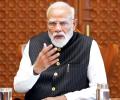
Prime Minister Narendra Modi will hold a video conference with chief ministers of most states to assess their preparedness and strategies in response to the ongoing conflict in West Asia.

The delegations from the US and Iran head to Islamabad on Friday, carrying a ceasefire that is already fraying, a Strait that is technically open and practically closed, and a negotiating agenda that would challenge even parties actually negotiating in good faith, which these groups are not. Prem Panicker continues his must read blog on the Iran War.

Dubai's core promise -- that it is an oasis untouched by regional storms -- has been tested in full public view. The coming months will show whether investors view the attacks as a short-lived disruption or a deeper signal of lasting risk, points out Asif Ullah Khan.

In crowded Mumbai trains, passengers, despite being crushed and unable to breathe, watch the IPL action on their phones. Oxygen may be optional, but the live score is not.

Israel and the United States had a plan. Iran punched back. And now the Gulf is reeling, the world is beginning to feel the pain and, as on date, no one in Washington or Tel Aviv appears willing to admit that the punch has landed, notes Prem Panicker, continuing his must-read blog on the war in the Middle East.

The purge in Washington does not pause the war. Strikes continue, Hormuz remains closed, and Brent crude is still dancing around $109 a barrel. For India, the command chaos in the Pentagon is another layer of uncertainty piled on five weeks of conflict that was already straining every buffer Delhi has.

Egypt, Pakistan, Saudi Arabia and Turkey met in Islamabad in what analysts say is the formal opening of a new diplomatic formation that could reshape the post-war regional order. Their immediate goal is a ceasefire; their larger ambition is to ensure that neither Iran nor Israel emerges from this war in a dominant position. Pakistan's foreign minister then flew directly to Beijing and mooted a Chinese role as guarantor of any eventual agreement. Prem Panicker continues his must read daily blog on the Gulf War.

Taking Kharg would give the US control over virtually all of Iran's oil exports and thus provide significant leverage, notes Prem Panicker in his must read daily blog on the Gulf War. It would also put American troops within range of Iran's remaining missiles, drones, and artillery on a piece of real estate that is just eight square miles in size, and just 15 miles from the Iranian mainland.

By all available indications, the White House drafted a face-saving note and handed it, ready-made, to Islamabad. Pakistani Prime Minister Shehbaz Sharif was supposed to then post it in the guise of a plea urging Trump to extend the deadline by two weeks 'to allow diplomacy to run its course'. Trump would then graciously accept Pakistan's 'request' and declare a ceasefire. Sharif dutifully posted the message on X. Except that he, or whoever was handling the account, forgot to delete the tell-tale first line visible in the edit history: 'Draft - Pakistan's PM Message on X'. Prem Panicker's must read blog on the Iran War.

Alliances fight wars effectively only when they share an endgame. If Israel acted without US knowledge, then the military alliance is operating without real coordination at the level of strategic targeting. Neither picture is reassuring in a war that is no longer regional in its consequences. Prem Panicker continues his must read daily blog on the Gulf War.

Fighting India beat Belgium in shoot-out to enter FIH Jr WC semifinals

...is a way out, notes Prem Panicker in his must read blog on the Iran War. What the indefinite extension produces is a prolonged condition of not-war-not-peace, in which oil markets cannot stabilise, Asian refineries cannot plan, European governments cannot stop subsidising consumption they cannot afford, and the next flashpoint -- a seized tanker, a miscalculated drone strike, a Truth Social post that claims too much -- is one news cycle away.

Tunisian filmmaker Kaouther Ben Hania discusses her docudrama 'The Voice of Hind Rajab,' which focuses on the tragic story of a six-year-old Palestinian girl killed during the Israel-Gaza conflict, and her motivations for making the film.

16 days into the war, US forces were already running out of ground-attack missiles and Israel is about to expend its entire Arrow interceptor missiles by end March. To be sure, the Iranians are watching closely and that explains their defiant stance that 'Iran will end the war when it decides to do so and when its conditions are met', notes Ambassador M K Bhadrakumar.

The question is no longer whether the war will expand. It has. The next few days will tell us whether the war stabilises around Hormuz or whether the Strait itself becomes the trigger for a far larger rupture. What to watch for over the next 48 hours is simple: Any move by the US toward direct naval control of the Strait; any credible Iranian attempt to disrupt or mine shipping lanes and, critically, whether energy infrastructure in the Gulf continues to be targeted.If those lines are crossed in tandem, the war will no longer be containable within the region.
